The special audit into spending and procurement for the 2023 Pacific Games has raised serious concerns about the possible misuse of customs duty exemptions, poor record keeping and a lack of proper financial authority at the National Hosting Authority (NHA).
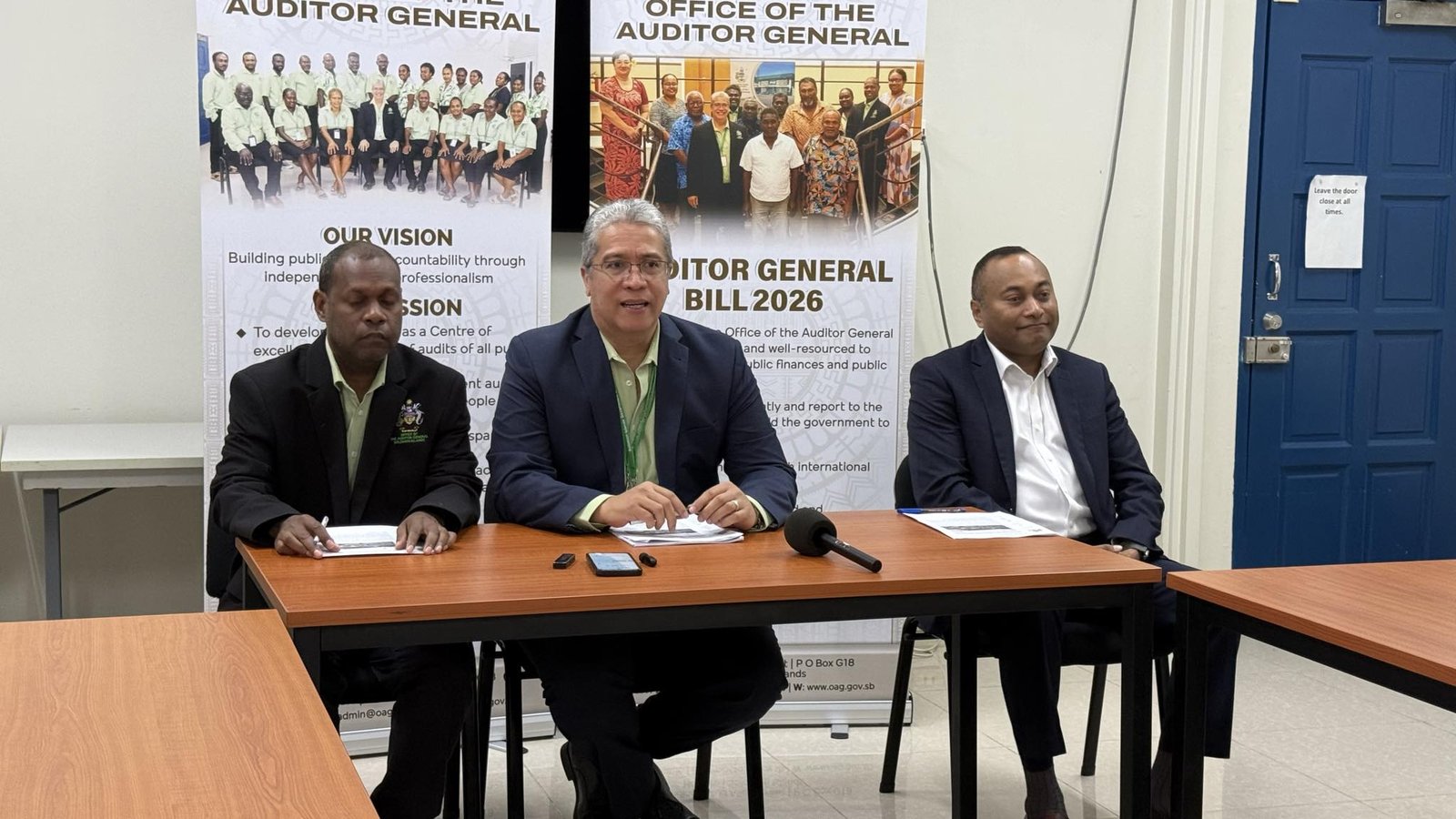
Outgoing Auditor General David Teika Dennis said the audit found weaknesses that exposed public money to serious risks.
The Government provided full customs and excise duty exemptions from 2019 to 2023 under its commitments in the Pacific Games Host Agreement. The exemptions were intended to support imports needed for the Games.
However, the audit found that many suppliers recorded duty-free imports worth more than the value of their contracts.
“ A high-level comparison of suppliers’ contract values and their recorded duty-free imports showed that, for most suppliers, the value of exempted imports was higher than the value of their contracts,” Mr Dennis said.
He cautioned that the figures could not be fully confirmed because the Customs system included other types of exemptions and important supporting documents were often missing.
Despite this limitation, a review of selected suppliers identified several concerns.
The Games catering contractor imported large quantities of equipment, cutlery and food-related items.
According to the audit, some of the goods appeared excessive or did not have a clear explanation showing why they were required for the Pacific Games.
Some items also appeared suitable for the contractor’s normal business activities rather than for the Games.
Concerns were also raised about imports connected to the Multipurpose Hall at Whiteriver School and the U-drainage contractor.
The audit found incomplete and inconsistent supporting documents, including differences between quantities shown on invoices and customs exemption forms.
Some purchases, including 1,000 standing fans and certain machinery, did not have clear explanations.
The audit therefore questioned whether all the items were genuinely required for the Games.
The SIFF Football Academy contractor was also identified as an area of concern.
The audit found major differences between quantities recorded on customs claim forms and those shown on invoices.
Important documents, including invoices and bills of lading, were missing.
Some imported machinery also appeared more suitable for general construction work than for the specific Football Academy project.
Mr Dennis said the findings raised serious questions about the use of customs exemptions.
“Overall, the review indicates possible overuse or misuse of customs exemptions, weak documentation, and uncertainty about whether all imported items were genuinely required for the Event,” he said.
“I will be referring these matters for further investigation.”
The Auditor General also criticised the quality of records kept by the NHA.
He said many records provided to auditors were late, incomplete, unsigned or missing.
The audit team had to repeatedly ask management for information and hold additional discussions to understand basic transactions and decisions.
In some cases, documents and explanations were only provided after the draft audit findings had already been issued.
Mr Dennis said this was a serious concern because auditors must have reliable evidence during the audit.
“Although I did not find conclusive evidence that documents had been falsified, the late provision of records showed that record keeping and audit readiness were weak,” he said.
He warned that poor record keeping can hide bad decisions, make audits difficult and weaken accountability.
Public officers who approve or manage government spending must keep complete, signed and organised records, he said.
“Where records are missing, incomplete or unreliable, there should be clear accountability for that failure,” Mr Dennis said.
The audit also questioned whether the NHA had enough qualified staff to properly manage the large amount of public money involved in the Games.
Mr Dennis said a project of this size needed a dedicated and qualified financial controller, or an equivalent officer, with enough time, skills and authority to maintain proper records.
The officer should also have been responsible for responding to audit requests and making sure transactions were properly approved and documented.
The NHA also needed experienced procurement staff to manage purchasing and contracts effectively.
“The weaknesses identified during the audit suggest that this support was not in place or not working as it should,” Mr Dennis said.
He said the situation needed urgent attention.
“This must be urgently addressed,” he said.
The audit also highlighted concerns about the legal authority used to spend money from the Pacific Games Special Fund.
Mr Dennis referred to a court ruling which found that the NHA did not have valid expenditure authority to spend money without an accounting warrant or advance warrant issued by the Permanent Secretary of Finance to the Authority’s accountable officer.
The court also found that a warrant issued to the accountable officer of the Office of the Prime Minister and Cabinet did not, by itself, authorise the NHA to spend money from the Special Fund.
This was important because money transferred into the Special Fund became subject to withdrawal decisions under the Pacific Games Act.
The court further declared that expenditure made under the blanket waiver part of the NHA’s modification policy was made without lawful authority and was, to that extent, null and void.
Mr Dennis said the court ruling supported the Office of the Auditor General’s position that special funds containing public money must follow the Public Financial Management Act 2013 unless specific legislation provides otherwise.
“This ruling reinforces OAG view that expenditure and procurement activity of special funds, unless otherwise specifically legislated for, must comply with the Public Financial Management Act 2013,” he said.
The Auditor General said the findings should not be treated as problems belonging only to the NHA or the 2023 Pacific Games.
Instead, he said they showed wider risks for government when major projects are carried out under pressure without proper planning, skilled staff, clear approvals and independent oversight.
“Poor planning is not an excuse for a poor process,” Mr Dennis said.
“If a procurement is urgent or complex, the need for planning and control is greater, not less.”
The special audit contains 11 recommendations aimed at improving procurement and financial management at the NHA.
The recommendations cover budgetary controls, procurement governance and principles, bid waiver processes, pre-qualification, supplier due diligence, conflict-of-interest procedures, tender evaluations, Games Tender Board decisions, financial bid differences, customs duty exemptions and further investigations by appropriate authorities.
Mr Dennis said the NHA’s response to most of the recommendations was concerning.
The NHA fully agreed with Recommendation 10, which dealt with customs exemptions and the need to investigate possible customs leakages.
However, Mr Dennis said the NHA’s other responses largely deflected, minimised or rejected the audit recommendations.
The NHA repeatedly relied on Section 46 of the Pacific Games Act 2017 to argue that standard government procurement rules did not legally apply to its operations.
However, Mr Dennis said the court ruling had made the legal position clearer.
“The Court ruling however makes it clear that Special Funds as public money are required to comply with the Public Financial Management Act,” he said.
He said special funds, including the NHA, should have their own budget codes and should be properly monitored by both the Ministry of Finance and Treasury and Parliament.
For projects of this size, he said accountable officers of special funds should receive specific financial warrants before spending public money.
The Auditor General also called for better record keeping across government.
Public entities should keep complete, signed and organised records for all important receipts, payments, approvals and decisions.
These records should be available when auditors conduct their work.
Officials responsible for financial transactions must understand that keeping proper records is part of their responsibility.
Mr Dennis said there should be clear accountability whenever important financial records are missing, incomplete or unreliable.
He also said major projects and special funds must have properly resourced financial management teams.
Such teams need qualified staff with enough time, skills and authority to maintain records, respond to audit requests and ensure spending is lawful, approved and properly documented.
Despite the serious findings, Mr Dennis acknowledged the success of the 2023 Pacific Games.
He said the event hosted by Solomon Islands was “arguably the best ever Pacific Games”.
However, he stressed that successful national events must also follow the country’s financial management laws.
“Whilst I acknowledge that the Pacific Games 2023 hosted in our beautiful Solomon Islands were arguably the best ever Pacific Games, our findings supported by the Court ruling highlight the importance of ensuring future such public events must follow public financial management laws and regulations to avoid waste, fraud, corruption and negligence to name a few,” he said.
Mr Dennis said he hoped the recommendations would help the Government and relevant ministries improve planning and management of future national events.
The audit findings now place pressure on authorities to investigate the possible misuse of customs exemptions and other issues identified by the Auditor General.
The report does not say that corruption was proven in every case. However, it identifies serious weaknesses that could expose public money to waste, fraud, favouritism and abuse.
The findings also show the importance of proper documentation when government spends millions of dollars.
Without complete records, auditors and the public may struggle to know where money went, why decisions were made and whether taxpayers received value for money.
Mr Dennis thanked KPMG contract auditors, particularly Mr Anare Manulevu and his team, for their support and expertise during the audit.
He also thanked his audit team and staff from the NHA, Ministry of Finance and Treasury and the Attorney General’s Chambers for their assistance.
The Auditor General’s overall message was that future national projects must have stronger financial controls from the beginning.
Major events may require urgent decisions, but urgency should not remove the need for proper approval, competition, documentation and accountability.
For Solomon Islands taxpayers, the audit highlights a simple principle: public money must be properly authorised, carefully managed and fully accounted for.
The government now faces the task of acting on the recommendations and ensuring that the weaknesses exposed by the Pacific Games audit are not repeated in future major projects.