BY JOHN HOUANIHAU
THE Ownership, Unity, and Responsibility Party (OUR Party), led by the Democratic Coalition Government for Advancement (DCGA), is calling on all political parties in the Solomon Islands to be realistic about the pressing issues affecting the country ahead of the 2024 Joint Election on April 17.
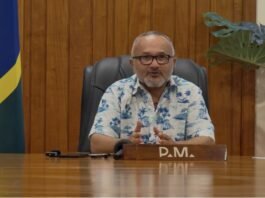
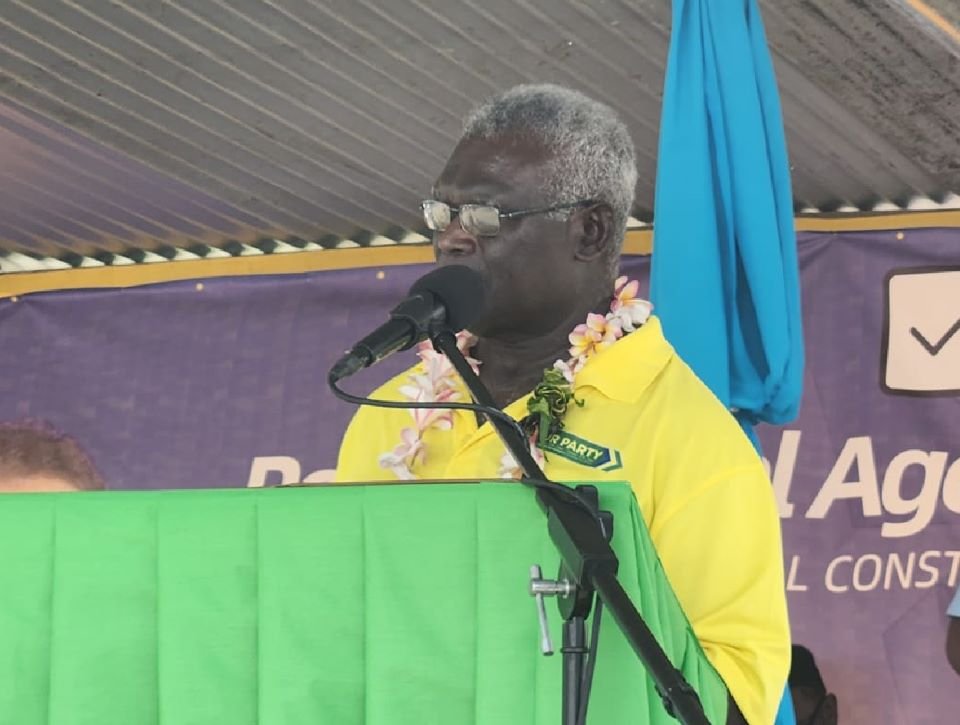
Caretaker Prime Minister (PM) Manasseh Sogavare made the statement when making his keynote address in Honiara on Tuesday last week when responding to the Matthew Wale and Rick Houenipwela led Coalition for Accountability Reform and Empowerment (CARE) policies on free education, negligence to essential health services, public servants’ pay rise and unemployment issues in the country.
Sogavare said that Solomon Islanders produce 44 new babies every day, and by multiplying that by 12 months, it would be 16,246 babies every year.
“That is the additional Solomon Islanders that need to be provided for in the future, including the education system. So, we must be realistic about this issue but not make false promises that we cannot deliver.
“Even if we talk about certain categories of scholars in the structure of our education system, it is still absurd. It is not affordable or sustainable. I want to say that, as much as any political government would like to pursue a total free education for this country, it is not practical, affordable, or sustainable,’’ the caretaker PM said.
Matthew Wale, leader of the Coalition for Accountability Reform and Empowerment (CARE Party), has recently vowed to revolutionize education in the Solomon Islands.
“As we seek to eradicate diseases like leprosy and polio from our nation, we must also strive to eliminate illiteracy.
“Under a CARE government, education will become compulsory from kindergarten to year 12, ensuring that every Solomon Islander receives a basic education,” Wale said.
In terms of education infrastructure in the country, Sogavare said that it is equal to one classroom per day, which makes this policy practically impossible.
He said that the DCGA has agreed that there’s a need for a review of the structure of the nation’s education services in terms of the cost of delivery and distribution, but it can come after a thorough assessment of the cost of delivery into the country, and the ministry is working on that.
“The cost of delivering education has been and will always be a joint responsibility between parents, the government, and our development partners. And you know what the education budget for our country is—more than $1 billion every year from a total budget of $4 billion funded by government revenue and the input from our partners,” he said.
In terms of increasing the salary of public servants across the board, Mr. Sogavare said that no government in the last 20 years has made any significant increase to the salary of public servants.
“We have to negotiate with the Central Bank of Solomon Islands (CBSI). You cannot just come and put in 20% or 30%. You can’t do that. We wanted to do that in the past, and the CBSI has warned us, saying that you can’t do that as the economy will suffer. So we must be realistic about these issues,” he said.
Sogavare pointed out that there is no short-term solution to creating employment for our people in this country.
“We need to be realistic about that while we thank Australia and New Zealand for providing job opportunities for our people under the Labour Mobility Scheme that aim at broadening our economic base, which should in the medium to long term result in improving our capacity to look after our people.
“When the country is desperate to create employment for our people and we are talking about discontinuing the scheme offered by Australia and New Zealand to help us and recalling our people to the Solomon Islands and promising them to create jobs in July this year, but you know what, the statistic tells us that the labor force in the Solomon Islands is estimated at about 368,842 in 2022 and has increased at an alarming rate, nearly to 16,000 every year.
“This includes Solomon Islands workers who are already in the employment sector.
“It is disturbing to recall the 6,000 people from the Labour Mobility Scheme when we have thousands of people who are still looking for jobs in this country. While we target these 6,000 people who are already employed, we should be concerned about the thousands of Solomon Islanders who are still looking for jobs,” Sogavare said.
He said that the Labour Mobility Scheme is one of the best short-term schemes to address short- to medium-term job creation in the country’s economy, with other benefits that bring into the country 240 million remittances every year.
“We need to understand this. There’s no short-term solution to creating employment for our people in this country. We need to be realistic about that while we thank Australia and New Zealand (NZ) for putting together a series of economic strategies that aim at broadening our economic base, which should in the medium to long term result in improving our capacity to like after our people,’’ he said.