BY JOY OFASIA
The Solomon Islands is losing an estimated US$79 million every year due to climate-related loss and damage, equivalent to 8.69 percent of the country’s Gross Domestic Product (GDP), according to a draft report highlighted during a recent media training in Honiara.
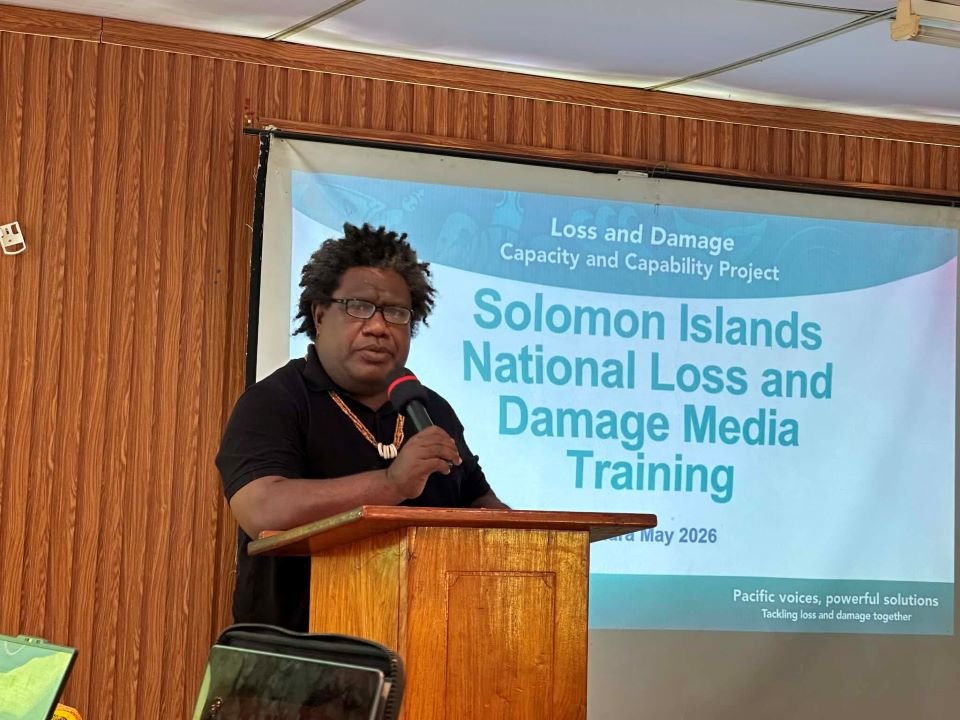
David Hiba, Permanent Secretary for the Ministry of Environment, Climate Change, Disaster Management and Meteorology, shared the figure during the training on National Loss and Damage, explaining that this loss comes from extreme weather events as well as slow changes like sea level rise and coastal erosion.
“Loss and damage is a new and emerging issue within the global climate change agenda,” Mr Hiba said. “It is separate from mitigation and adaptation, and it needs its own financing mechanism. This is not just an environmental concern, it is a national development challenge, a growing economic burden and a human crisis.”
He reminded participants of the devastating 2014 Honiara floods. A post-disaster assessment by the World Bank recorded damages of US$107.8 million—9.2 percent of the country’s GDP at the time. The floods claimed 22 lives and affected more than 50,000 people across the country. “Beyond the financial losses, many impacts cannot be measured in money,” Mr Hiba said.
The Permanent Secretary also highlighted the threat of rising seas. At least five islands in the Solomon Islands have already been permanently lost. “For those communities, their histories and sense of place cannot be replaced,” he said, citing the Solomon Islands National Climate Change Policy and scientific studies by Simon Howden published in Environmental Research Letters.
Mr Hiba emphasized that loss and damage is about people and communities, not just numbers. “It is about the lived experiences of those directly affected by climate change,” he said.
He also pointed out that Pacific Island nations have long pushed for recognition of loss and damage at the international level. “Our voices need to be heard because what we are experiencing is real, and urgent action is needed to protect our people, our islands, and our future,” Mr Hiba added.
The training aims to equip journalists with the knowledge to report on these challenges, helping the world understand both the economic and human impacts of climate change in the Solomon Islands.