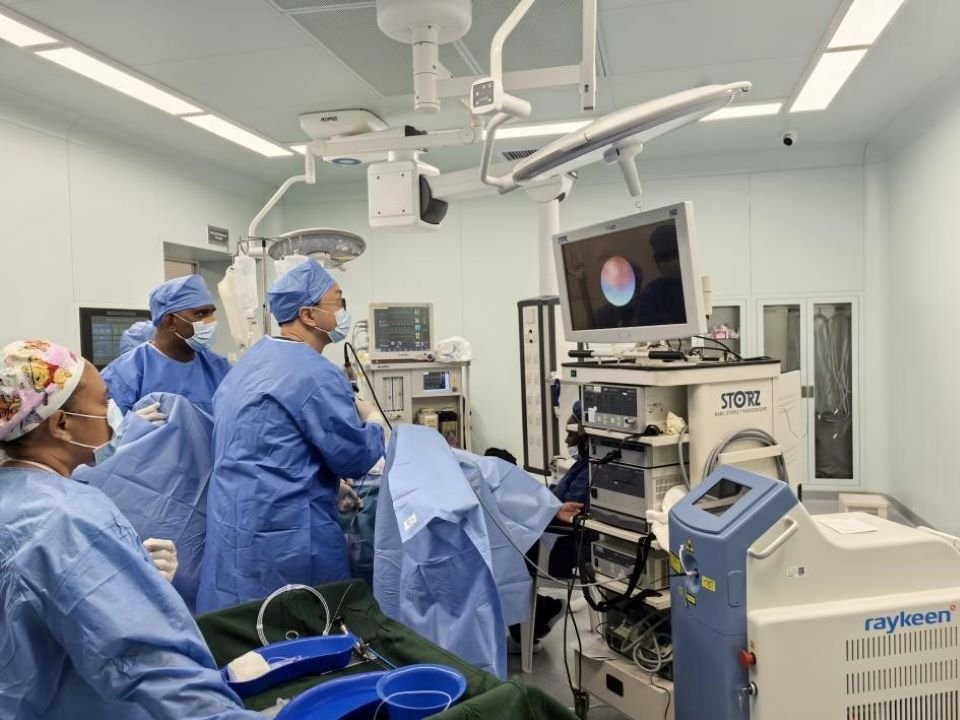
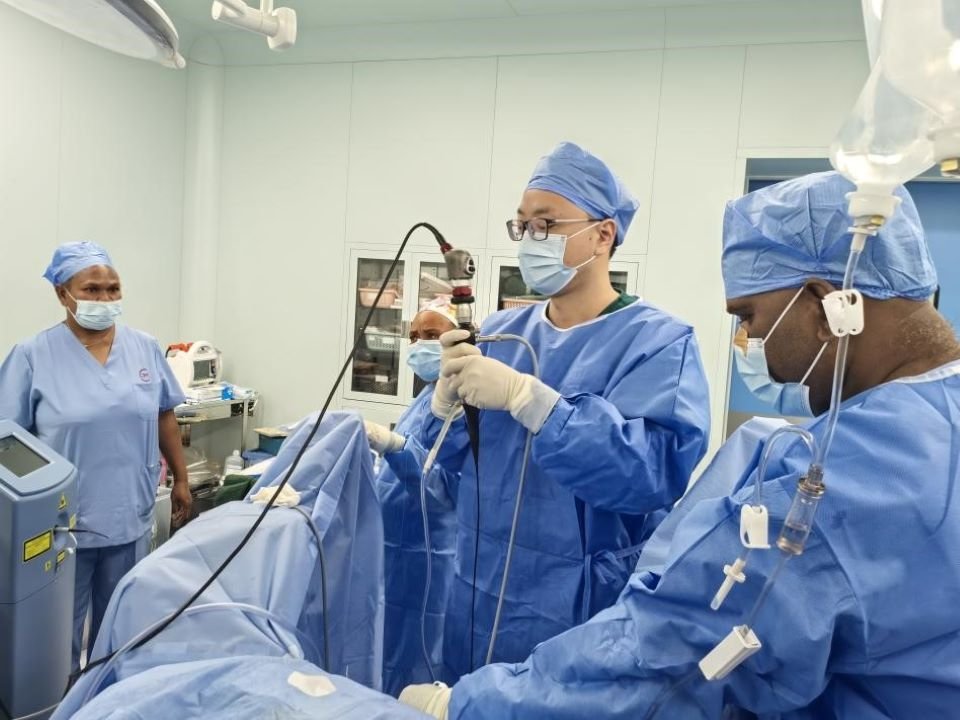
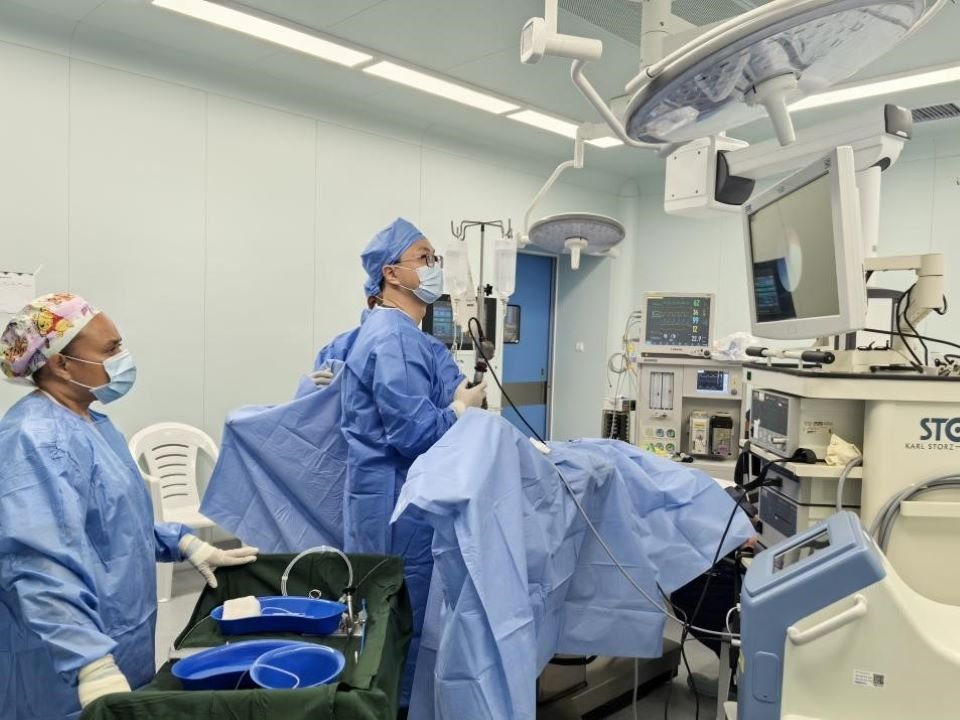
The 4th China Medical Team worked closely with the urology team of the National Referral Hospital (NRH) on January 22nd, 2026, to successfully perform a flexible ureteroscopic holmium laser lithotripsy on a patient with right kidney stones.
This marked the first minimally invasive kidney stone lithotripsy procedure in the medical history of Solomon Islands, signifying a leap forward in the diagnosis and treatment of urinary tract stones and ushering China – Solomon Islands urological cooperation into a new stage of development.
Kidney stones are a high-incidence disease in Solomon Islands. Due to limited medical resources and delayed presentation, some patients are diagnosed only after stones have significantly enlarged or become impacted, often accompanied by hydronephrosis or even renal function impairment, posing serious health risks. For a long time, such patients have mainly relied on traditional open surgery, which involves greater trauma, higher risk, longer recovery periods, and substantial physical, psychological, and financial burdens—creating an urgent clinical need for improved treatment options.

This longstanding challenge has been systematically addressed through the China–Solomon Islands Urology Minimally Invasive Surgery Center Project, initiated by the National Health Commission of China. Through comprehensive support including equipment donations, technical transfer, and personnel training, key equipment such as holmium laser lithotripsy systems and laser fibers has been introduced to Solomon Islands, laying a solid hardware foundation for the adoption of minimally invasive techniques. China–Solomon Islands medical cooperation have already successfully filled multiple technical gaps, including minimally invasive holmium laser lithotripsy for bladder and ureteral stones, accumulating substantial clinical experience and strong teamwork.
During this procedure, Dr. Chen Xulong from the China Medical Team and Dr. Augustine Melly from the NRH urology department conducted thorough preoperative evaluations and carefully formulated a surgical plan, further extending minimally invasive technology to the treatment of kidney stones. The surgery was performed entirely through the body’s natural orifice by inserting a flexible ureteroscope, precisely reaching the renal lesion.
The stone was accurately fragmented using a holmium laser and efficiently removed with the assistance of a negative-pressure suction system, fully demonstrating the advantages of minimally invasive surgery—no external incision, minimal trauma, high precision, and rapid recovery.
Postoperatively, the patient recovered smoothly without significant discomfort and quickly returned to normal life, clearly highlighting the value of minimally invasive surgery in reducing perioperative risks and accelerating rehabilitation. With the successful completion of this procedure, Solomon Islands has reached an important milestone in the management of urinary stone disease. The treatment model, which has long relied predominantly on traditional open surgery, is now beginning to shift toward minimally invasive approaches, with open or alternative techniques reserved for exceptionally large stones or complex anatomical conditions.The local minimally invasive treatment system is becoming increasingly well established.
“Through my studies in China and the meticulous mentorship of Chinese doctors, I have mastered internationally advanced minimally invasive techniques. Today, I am able to independently relieve my fellow citizens of their suffering—something that once seemed unimaginable. I am deeply grateful for the opportunities created by China – Solomon Islands medical cooperation. This partnership has not only elevated our medical capabilities but has also brought renewed hope to local patients.” said Augustine Melly with heartfelt emotion.
Zhao Xueke, leader of the 4th China Medical Team, stated that the success of this surgery not only fills the technical gap in minimally invasive kidney stone treatment in the country, but also marks the upgrade of China – Solomon Islands urological cooperation from “single-technology breakthroughs” to a new phase of systematic capacity building. Looking ahead, the medical team will continue to use the China–Solomon Islands Urology Minimally Invasive Surgery Center Project as a platform to strengthen training for local medical staff, promote the standardized and routine implementation of minimally invasive techniques, and ensure that more stone patients can access safe, efficient, and high-quality advanced medical services locally—without the need for long-distance travel—thereby injecting sustained momentum into the deepening of China–Solomon Islands medical and health cooperation and the building of a global community of health for all.