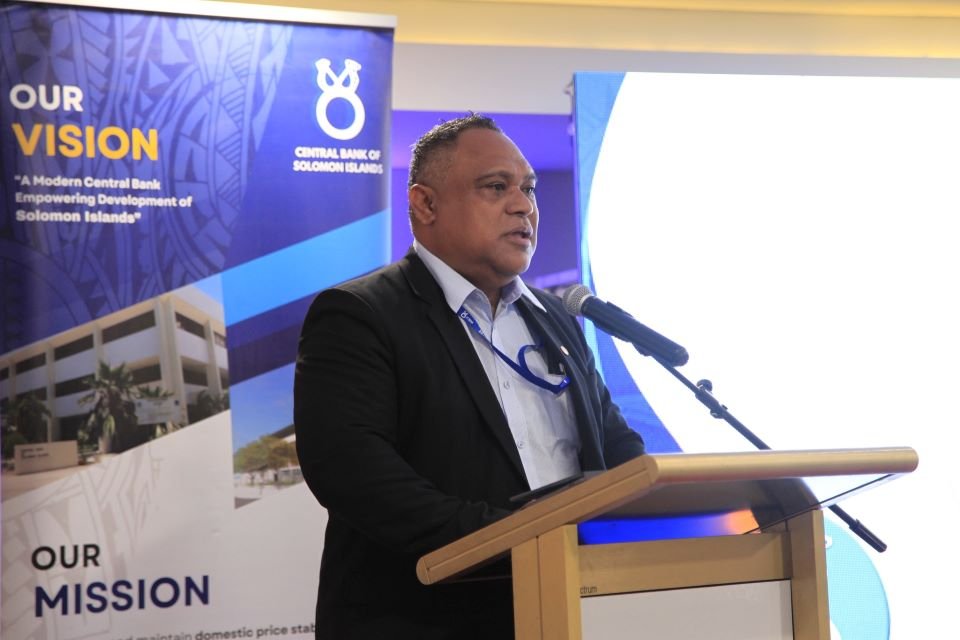
Dr. Luke Forau
Governor, Central Bank of Solomon Islands
Heritage Park Hotel
Honiara – 30th April, 2026
Statement By CBSI Governor, Dr Luke Forau, at the Launch of the 2025 CBSI
Annual Report, on Thursday 30th April, 2026 at the Heritage Park Hotel
1. Salutation
• The Honorable Minister of Finance & Treasury
• Honorable ministers of the Crown, and Members of Parliament
• Permanent Secretary of Finance and Treasury
• Other Permanent Secretaries, and Senior Government Officials
• Excellencies Representatives of the Diplomatic Corps
• Central Bank Board of Directors
• Heads of Financial Institutions
• Heads of Statutory Authorities
• Representatives of Non-Government Organizations
• Representatives of the Private Sector
• Solomon Islands Chamber of Commerce Board and CEO
• Representatives of the Media
• Distinguished Guests
• Ladies and gentlemen
2. Introduction and Context
It is my pleasure to warmly welcome you all to the Bank’s 2025 Annual Report
Launch. Thank you for coming along.
I will begin by providing a brief assessment of the country’s economic performance
in 2025, and share some insights on where we should focus our efforts in 2026.
Please note, this is not about prescribing policies—rather it is about guiding our
attention to the areas where action and investment can make the most meaningful
impact for our people.
Ladies and Gentlemen, the global economy remains uncertain. Geopolitical
tensions are rising, and commodity prices remain volatile—especially with the
global oil markets, where tensions in the Middle East continue to fuel instability. For
small, open economies like ours, such shocks directly transmit into our economy
through rising costs, putting pressure on businesses and strain on households;
these are realities that we cannot ignore.
At last year’s Annual Report Launch, we emphasized the importance of building a
stronger future grounded on clear goals, shared ownership, and a renewed sense
of determination and urgency to deliver excellence. That message remains just as
relevant today. However, this year we must go further by embedding a theme that
entails “Fit for the Times: Prioritizing inclusive and resilient growth”. It reflects
a growing recognition that resilience and inclusion are inseparable, nor are they
1
optional; they are foundational upon which sustainable growth and prosperity must
be built. The real question is how decisively and how quickly we act.
I will return to it later. For now, let me provide a snapshot of last year’s economic
performance and the outlook for this year.
3. Brief Economic update in 2025 and Economic outlook
Global economy
In 2025, global economy grew by 3.4%1. The impact of the U.S. trade tariffs proved
less severe than initially anticipated, highlighting the global economy’s ability to
adapt to policy uncertainty. At the same time, global inflation eased further to 4.1%
as price pressures moderated and inflation continued to converge toward central
banks’ targets.
Domestic Economic growth
On the domestic front, the Solomon Islands’ economy gained stronger momentum
in 2025, expanding by 3.6% compared to 3.0% in 2024. The gains came from solid
growths across key sectors such as mining, construction, agriculture,
communications, wholesale and retail trade, and transport.
Stronger performance in mining and construction reflected increased investments
and ongoing infrastructure development, while gains in communications,
wholesale and retail, and transport signaled increased domestic demand and
improved connectivity across the nation.
Labour conditions
Labour market conditions remained stable in 2025, with total SINPF contributors, a
proxy for formal sector employment, increasing by 4% (2,448 new contributors) to
61,829 from 59,381 in 2024. The increase reflected employment opportunities in
the wholesale and retail trade, mining, construction, hospitality, agriculture, and the
services sector.
Inflation
Inflation moderated in 2025, with headline inflation declining to 1.6% from 4.6% in
2024, this is driven by lower domestic and imported price pressures. Domestic
inflation eased to 2.2% due to improved fruit and vegetables supplies, while
imported inflation fell to 0.2% amid lower global prices and fuel costs, supported
by favourable exchange rate.
External conditions
On the external sector, the country’s overall balance of payments surplus improved
further to $938 million, more than double the $350 million recorded in the previous
year. This improvement was largely driven by a surplus in the current account due
to strong mineral export receipts and higher donor inflows. Consequently, gross
foreign reserves increased by 14% to $6,620 million, equivalent to 12 months of
imports—well above the CBSI’s six-month policy threshold—and offering a strong
buffer against short-term external shocks.
For those curious about remittances from seasonal workers, total cash remittances
from the labour mobility scheme, seasonal workers and the RSE in 2025 dropped
by 1% to $471 million. This figure does not include those who brought in cash with
them on the plane. On the bigger picture, workers continue to directly support
families, households, and communities across the Solomon Islands.
Monetary Policy
Monetary Policy stance during the year has been accommodative to support
growth while at the same time ensuring inflation is tamed. Part of the policy was the
stabilization of the Solomon dollar to ensure that imported inflation is contained.
This may seem inconsistent with the accommodative stance, but it did work for our
purpose. In times of uncertainty combined with market failure, it is only fitting that
specific and targeted fit-for-purpose policies are implemented to cushion the
adverse impact.
Fiscal Policy
On fiscal developments, the Government maintained the expansionary fiscal
stance, with the fiscal deficit widening by 4% of GDP ($639 million) in 2025 from 2%
of GDP ($282 million) in 2024. This has resulted in the Government debt increasing
to 30% of GDP as compared to 26% of GDP in the previous year.2
Economic Outlook
Prior to the conflict, global growth was expected to remain at 3.3% in 2026, to be
supported by advances in artificial intelligence, accommodative financial
conditions, and continued monetary and fiscal policy support. With the Middle East
conflict, the IMF3 has revised down global growth for 2026 to 3.1%. Global inflation
is also projected to rise slightly to 4.4% in 2026, reversing the earlier expectation
that inflation would continue to ease.
For Solomon Islands economy, the Central Bank’s earlier growth projection of 3.8%
was revised down to 3.6% following the Middle East crisis. Then came the Tropical
Cyclone Maila, growth has been further revised down to 3.4%. This growth is
expected to be driven by agriculture, fishing, mining, construction, wholesale and
retail trade, and communications. However, the outlook remains uncertain and risks
are tilted to the downside. Moreover, external shocks such as adverse export price
movements, ongoing Middle East crisis, and the lingering impact of Cyclone Maila
could negatively affect these sectors.
In the medium term, the economy is projected to grow by an average of around
4.5%, assuming a broad-based expansion across key sectors including mining,
agriculture, construction, and services. These projections depend critically on the
quality of policies developed and implemented; for without effective execution,
they would remain largely aspirational.
Challenges, risks and opportunities
The risks to the outlook are tilted to the downside. Global uncertainties continue to
pose challenges, while domestically, we face natural disasters, investment gaps,
and ongoing leadership and governance issues. On the flip side, there are clear
opportunities; the private sector resilience and the willingness of our development
partners have generously supported us on infrastructure and digital technology –
laying the foundation for our future growth.
Baseline growth and ambitious growth path forward
Before we return to our theme, let’s take a moment to reflect on where we are today.
Between 2015 and 2019, our economy enjoyed steady growth of around 3% per
year, on average. But this progress was sharply disrupted between 2020 and 2022,
when the COVID-19 pandemic pushed us into recession. 4
Since then, we have been on the path to recovery. From 2023 to 2025, growth has
returned, averaging 3.1% per year, with growth for 2025 estimated at 3.6%, up from
3.0% in 2024.
Yes, we are growing—but not fast enough, and not broadly enough. We are falling
short of our 5% growth target and of delivering the inclusive growth our people
deserve. And might I add, with such performance we may not be able to graduate
from an LDC status, come 2027.
When we dig deeper, it becomes clear why. Our growth depends heavily on a few
sectors. Strip out mining, and our 3.6% growth falls to around 2.8% for 2025 and
2026. This highlights a structural challenge: our growth is still narrow-based and
too concentrated.
The challenge before us is clear: we must not just grow—but do things differently to
grow. We must build an economy that is more inclusive, more resilient, and more
sustainable.
Let us now consider a more ambitious path—a “big push” scenario. What would it
take to lift growth to at least 5%? It would require coordinated and deliberate action
across all sectors of the economy. It would demand bold, transformational change—
not incremental adjustments.
And this brings us back to our theme: “Fit for the Times: Prioritizing Inclusive
and Resilient Growth.”
Being fit for the times means more than responding to today’s challenges. It means
preparing our economy to thrive in a world that is constantly changing. It means
ensuring that growth is not only strong, but shared by all. It means building
resilience so that shocks—whether global or domestic—do not derail our progress.
They need to go together. Inclusive growth without resilience will only lift people
out of poverty, but leaves them vulnerable to shocks. Similarly, resilient growth
without inclusiveness, only protects systems and assets, but still widens inequality
and social tension. In short, we need growth that is fair, durable, and future-ready.
This “big push” requires all of us. It calls on the private sector to innovate, the
government to enable, communities to engage, and every citizen to see themselves
as part of this transformation.
4. Prioritizing Economic Sectors to drive inclusive and resilient growth
Let me begin with the sector that can drive the widest impact: agriculture.
I mentioned this last year, but I want to mention it again because agriculture
remains the most powerful and impactful engine of inclusive growth. It is where
opportunity reaches the most people—across our provinces, our communities, and
our households.
As we pursue our 5% growth target, there is enormous potential to expand
production by leveraging the comparative advantages of our provinces.
Guadalcanal, Western, and Central Provinces have strong potential in copra
production, while Guadalcanal, Makira, and Malaita are well-positioned for cocoa.
The potential is clear. The real question is: can we organize and support our farmers
to fully realize it?
With the right tools and mindset, production could increase dramatically:
• Copra output could rise well beyond 30,000 tons
• Coconut oil production could exceed 15,000 tons
• Cocoa output could triple to over 15,000 tons
• Seaweed, an emerging commodity, could grow from 5,309 tons to over
15,000 tons
• Kava production could expand from 3 tons to 9 tons
But the opportunity does not stop at production. Agriculture is, in many ways, the
mother of all industries. Its true value lies in the linkages it creates across the
economy.
What if we processed more of what we grow? What if, instead of exporting raw
cocoa, we produced our own chocolate—right here at home? That is where the
multiplier effects kick in: more jobs, more value retained locally, stronger links to
tourism, and a more resilient domestic economy. This is the shift we must make—
from volume to value.
Agriculture also underpins food and nutritional security. Our high dependence on
imported food exposes households to price volatility and supply disruptions.
Strengthening domestic production of staples such as cassava, taro, and potatoes
supports nutrition, sustains rural livelihoods, and reduces vulnerability to external
shocks.
In 2025, food imports accounted for 25% of the country’s total imports, with rice
alone representing 27% of food imports—worth over $398 million. Looking at the
bigger picture, total food imports reached $1,505 million, which is significantly
higher than our agricultural exports of 1,007 million (a deficit of $498 million). In
simple terms, a large share of what we consume is coming from abroad rather than
being produced locally—and that’s a gap we need to address. I commend the
Ministry of Agriculture and Livestock for piloting the rice project in Malaita Province,
an important step towards reducing our dependence on rice imports.
Beyond agriculture, tourism offers untapped potential. I welcome the
Government’s strong focus on this sector. This year, the tourism budget jumped
from $10 million to $46.4 million—a massive $36.4 million boost—showing real
commitment to unlocking that potential with the Government’s bold ambition to
achieve 100,000 visitor arrivals by 2035, up from 27,239 visitor arrivals recorded at
the end of last year. Imagine the impact—not just more foreign exchange earnings,
but thousands of new jobs and the positive spill-overs into our communities. With
the right investments in infrastructure, connectivity, and service quality, tourism can
become a powerful engine of inclusive growth. And remember, we need a
minimum of 700 rooms, so says former CEO of the Tourist Solomons, the late
Iosefa.
At the same time, digital transformation is a game changer. Expanding mobile
financial services can improve access to finance, lower transaction costs, and bring
more of our people into the formal economy. Broadly, we are seeing these benefits
in practice, though there is more to do. Under our third National Financial Inclusion
Strategy 2021-2025, we had a target of 400,000 financial account users, with 50%
of whom must be women. By end of 2025, we reached 88% (352,000), a shortfall of
48,000. Of this, 44% (or 156,000) were women. This is an encouraging progress,
but there is still more to do to close the gap. The second national goal was to reach
1,150 access points. We have surpassed the target to reach 6,155 access points in
2025. This includes agents, EFTPOS terminals and merchants, ATMs and branches.
Protecting our investments is just as important as growing them. Innovative
initiatives, such as the parametric insurance launched last year, are helping farmers
and communities to withstand climate-related shocks and safeguard hard-earned
progress. For example, during the recent rainy spell in January and early February,
35 policyholders received payouts under the recently introduced parametric
insurance scheme, and I encourage more farmers to participate and benefit from
this protection.
Similarly, on a national level, the Government has made a wise decision to protect
the country against cyclones, earthquake, tsunami, and flooding. For example, the
recent cyclone Maila has triggered payout from the Pacific Catastrophic Risk
Insurance Company (PCRIC) to the SIG USD$500,000, which only paid US$45k in
premium last November. Given the frequency of cyclones, the Government can
benefit more by increasing the policy premium.
We must also accelerate renewable energy. Our reliance on imported fossil fuels
leaves us vulnerable to volatile global prices, affecting agriculture, fisheries, and
transport.
Coordinated action by government and private sector is critical to safeguard
households, businesses, and livelihoods. Fast-tracking renewable energy projects,
including solar expansion and the Tina Hydropower Project, will reduce exposure
to external shocks, lower costs, and strengthen national resilience. These
investments will enhance productivity, reduce the cost of doing business, and
create a more stable foundation for sustainable growth. Resilience is not just about
withstanding shocks—it’s about bouncing forward. Not back. Forward!
5. Pillars for Turning Investment into Impact
Stepping up investment is essential—but investment alone is not enough. We must
ensure it translates into real, tangible improvements in our people’s lives. This
requires a practical framework built around four key pillars: people, tools, data, and
systems.
First, people are central to both growth and resilience. Investing in
farmers/business operators is crucial to ensure they are well- equipped to adapt to
changing conditions, and policymakers must have the capacity to define growth
paths and respond to evolving circumstances. Provincial staff need upskilling, and
outreach must reach every community
Second, is technology. Productivity gains must be achieved within existing
constraints. In agriculture and fisheries, practical and scalable technologies – such
as improved planting materials, resilient farming practices, and basic storage and
processing – can stabilize output and incomes while reducing exposure to price
and weather volatility. Embracing technology, strengthening value chains, and
linking farmers to markets, we can ensure these tools deliver maximum impact.
Technology choices must be effective, affordable, and tailored to our local context.
Third, good policy depends on reliable data. Reliable information on production,
prices, imports, and nutrition outcomes allows us to monitor performance, assess
risks, and plan proactively. Comprehensive databases, including a farmer registry,
will ensure financial interventions are targeted and evidence-based. At the national
level, the Government must fully resource the National Statistics Office. They are
the only mandated office in the country to collect data. It is critically important that
capacity at the NSO is strengthen.
Fourth, systems must integrate people, tools, and data into actionable policies.
Monitoring must feed into decision-making at national and provincial levels, with
clear feedback loops for accountability and continuous improvement.
6. CBSI Operations
Let me close by briefly reflecting on the Bank’s key operations last year.
On governance, the Bank continued to benefit from the oversight and guidance of
its full nine-member Board of Directors. Day-to-day operations were carried out by
11 departments, all working to deliver the Bank’s mandate. During the year, the
Board endorsed the Mid-Term Review of the Bank’s Strategic Plan 2024–2027 and
its translation into the development of the 2026 Annual Strategic Operating Plan —
helping to sharpen our focus, strengthen accountability, and better align our
priorities and resources. The Bank’s Strategic Plan is aligned to the Government’s
National Development Strategy (NDS) five objectives. Moreover, all our mandates,
regulations, and internal policies are also aligned to the UN’s SDGs.
The Bank’s workforce also continued to expand and evolve. Staff numbers
increased to 201, up from 187 in 2024, reflecting our deliberate investment in
institutional capability. We are proud to be an equal opportunity employer, with
women now making up 40 percent of our workforce, supported by our female
empowerment initiative, FemPower. At the same time, we continued to invest in our
people.
On infrastructure, the Bank prioritized the upkeep of its existing facilities while also
planning for the future. Following the acquisition of the adjacent land next to CBSI
Head Quarter, we progressed the redesign of our new Head Office— providing a
clear vision for modern infrastructure to support our long-term institutional needs.
7. Conclusion
Finally, let me sincerely thank everyone who has provided data, shared information,
and made time to meet with us in support of our economic assessment throughout
the year.
Foremost, I’d like to recognize the Board for its important oversight role and my
staff at the Central Bank for their continued support and dedication.
Thank you for listening and may God Bless you all.