


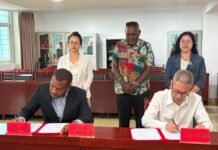



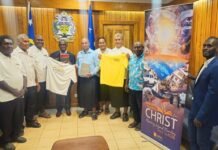


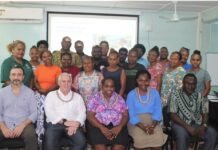
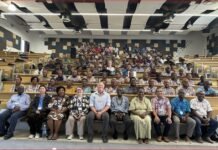
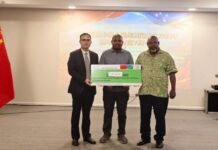
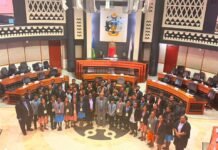
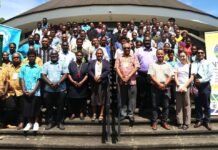


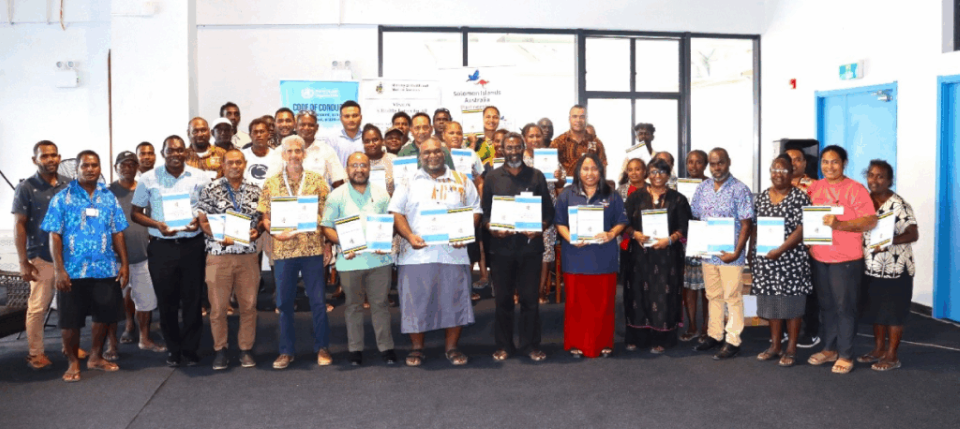
The Ministry of Health and Medical Services (MHMS) has launched the updated Tuberculosis Guidelines 2024 and the Tuberculosis National Strategic Plan 2024–2026.
The launch was led by the MHMS TB and Leprosy Division, supported by key health partners including the World Health Organization, World Vision/Global Fund, Australia, and the Burnet Institute.
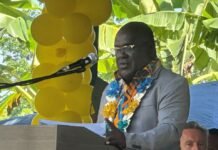
Speaking at the launch, Deputy Secretary for Health Improvement, Dr. Nemia Bainivalu, described the release of these documents as a major milestone in the national response to TB. He emphasized that the updated guidelines and strategic plan reaffirm the ministry’s commitment to delivering evidence-based, person-centered TB services.
“The scale and urgency of the TB challenge demand decisive action. These documents provide the framework for a more unified, effective, and timely response,” Dr. Bainivalu said.
He highlighted that the MHMS 2022–2031 National Strategic Plan calls for TB to be brought under control by:
- Ensuring universal access to TB prevention services, with the goal of ending TB in the Solomon Islands by 2035.
- Tracking progress on malaria and TB elimination through aggressive prevention, diagnosis, and treatment.
- Monitoring TB incidence, treatment coverage, and treatment success annually through DHIS2 and global reporting systems.
While the national TB program has consistently achieved strong treatment success rates of 92–96%, recent data shows a worsening epidemiological situation. TB incidence has risen sharply from 60 per 100,000 in 2021 to 123 per 100,000 in 2025, while coverage has fallen to 45%, leaving more than half of estimated TB cases undiagnosed or untreated.

“These trends underscore the urgent need to strengthen case detection, surveillance, prevention, and program performance,” Dr. Bainivalu noted.
Key updates in the TB Guidelines 2024 include:
- A modern, person-centered ambulatory model of care.
- Updated diagnostic algorithms, including Xpert Ultra and improved sputum quality SOPs.
- Clear treatment pathways for drug-sensitive and drug-resistant TB.
- Expanded guidance on TB in children, contact investigation, latent TB infection, preventive treatment regimens, and infection prevention and control.
- Integrated care for special populations and enhanced patient support.
- Strengthened recording, reporting, and data systems.
The TB National Strategic Plan 2024–2026 commits to:
- Achieving 100% coverage and timeliness of TB surveillance by 2025.
- Scaling up active case finding using portable X-ray and molecular tools.
- Systematic screening of household contacts and people living with HIV.
- Introducing ambulatory care pilots and structured patient support.
- Strengthening procurement and supply chain visibility.
- Implementing FAST (Find cases Actively, separate safely, Treat effectively) and other IPC measures.
Dr. Bainivalu stressed that the launch signals implementation, not symbolism. MHMS will work with provinces and partners to roll out the guidelines, train staff, strengthen supervision, deploy revised monitoring tools, and expand community-based TB education, contact tracing, and preventive treatment delivery.
He thanked healthcare professionals, the National TB and Leprosy Program, and technical and donor partners—including WHO, the Burnet Institute, Australia, and the Global Fund—for their support.
“The guidelines and strategy will only be as strong as our commitment to implement them. I urge every healthcare worker, program manager, and partner to embrace these changes and ensure that every Solomon Islander has access to timely, safe, and high-quality TB care and prevention,” Dr. Bainivalu said.
Health development partners congratulated MHMS on the launch and pledged their continued support.
“With only one-third of TB cases receiving contact tracing in 2025, and only one-third of cases being cured with two negative sputum tests, it is clear that we must strengthen our efforts,” said Dr Howard Sobel, WHO Representative in Solomon Islands. “ WHO remains committed to supporting the Solomon Islands in scaling up prevention, early detection, and community-based care to ensure that every TB case is traced, treated, and cured. Together, we can move closer to ending TB and improving the health and well-being of all affected individuals and families.”
Australia’s High Commissioner, Jeff Roach, said Australia was committed to helping eliminate TB in Solomon Islands.
“We will continue to work together with other partners under the National Strategic Plan, and are ready to support implementation efforts to ensure we meet the TB challenge together,’ High Commissioner Roach said.