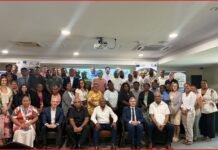








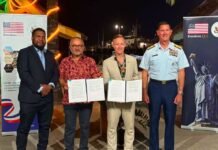










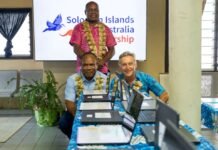





A delegation from the Ministry of Health and Medical Services (MHMS) recently travelled to New Delhi, India, to advance discussions with the Government of India through its relevant ministries, line departments, selected hospitals and State-accredited pharmaceutical agencies, as both countries work towards the full implementation of two Memoranda of Understanding (MOUs) on Health and Medical Care Cooperation and the Recognition of the Indian Pharmacopoeia by Solomon Islands.
The delegation was led by Deputy Secretary – Corporate, Ministry of Health and Medical Services, Mr. Layten Jacob, and included senior officials from MHMS, the Chief Executive Officer of the National Referral Hospital, Dr. George W. Malefoasi, Director of the National Medical Store, Mr. Solomon Bosa, and Manager of the National Medical Store, Mr. Wesley Kukutu.
The Solomon Islands High Commissioner to India, His Excellency Mr. Anthony Makabo, also joined the delegation upon its arrival in New Delhi for an introductory courtesy meeting with the Ministry of Health and Family Welfare of the Government of India.
The opening session with the Director of International Cooperation at the Ministry of Health and Family Welfare, Government of India, Dr. Poonam Meena, set the basis for the subsequent series of meetings held during the week.
Dr. Meena warmly welcomed the Solomon Islands delegation to New Delhi and conveyed the Indian Government’s appreciation for Solomon Islands’ commitment and readiness to advance areas of mutual cooperation in health, medical care and pharmaceuticals.
The Solomon Islands delegation also provided an overview of the key objectives of the mission, with emphasis on:
- Identifying opportunities for technical cooperation, training and capacity building;
- Developing a proper understanding of the government-to-government engagement model;
- Gathering and reviewing information on similar arrangements India has with other countries and partners;
- Obtaining detailed information on the Indian pharmaceutical market, including products, pricing, regulatory requirements and quality assurance;
- Visiting pharmaceutical manufacturing sites and laboratories recommended and accredited by the Indian Government;
- Identifying selected institutions for fellowship and medical exchange programmes;
- Identifying opportunities for the deployment of medical sub-specialists to Solomon Islands; and
- Identifying other avenues for patient referral opportunities.
Also present during the initial session were representatives from the Central Drugs Standard Control Organisation (CDSCO), a division under India’s Ministry of Health responsible for regulating and providing oversight on the safety, efficacy and quality of medical products manufactured in India and exported globally.
The engagement provided an opportunity for direct discussions on technical matters, including product quality and safety, regulatory compliance, manufacturer credibility and supply chain reliability.
The discussions focused on the need for strengthened governance, procurement accountability and a trusted supply chain system to ensure the reliable and efficient availability of medicines and other essential health commodities.
During the official visit, the delegation also met with other Indian Government authorities, institutions and healthcare service providers.
These included the Department of Pharmaceuticals under the Ministry of Chemicals and Fertilizers, the India Pharmacopoeia Commission (IPC), including a tour of the IPC laboratory site in Ghaziabad, Uttar Pradesh, and selected hospitals.
The delegation visited the All India Institute of Medical Sciences (AIIMS), a State-owned and operated institution, as well as Yashoda Medicity Hospital, a private healthcare provider.
The week-long official visit to New Delhi represents a step forward towards the implementation of the two healthcare and pharmaceutical MOUs signed between Solomon Islands and India.
Officials from both Governments discussed and settled on a pathway to guide and develop cooperation between Solomon Islands and India in the areas of health, medical care and pharmaceuticals.
Agreed Outcomes
Going forward, some of the agreed outcomes anticipated by both parties include:
- Direct procurement by Solomon Islands of medicines and consumables from State-accredited suppliers in India, with the India Pharmacopoeia Commission providing technical support and guidance to advocate for quality, genuine and new medicines and vaccines for Solomon Islands;
- Discussions between the Ministry of Health and Family Welfare of the Government of India and the Ministry of Health and Medical Services of the Government of Solomon Islands on a proposal to establish a Joint Working Committee responsible for overseeing health, medical care and pharmaceutical-related cooperation;
- Support from the Ministry of Health and Family Welfare of the Government of India to facilitate the purchase of Indian pharmaceutical products by Solomon Islands;
- A proposal for an MOU and collaboration with India’s Drug Regulatory Authority and Department of Pharmacology;
- A proposal for an MOU and collaboration with an Indian-accredited pharmacy;
- A proposal for an MOU with Yashoda Medicity Hospital as a tertiary and specialist referral hospital for Solomon Islands; and
- Identification of a potential recruitment agent for medical specialists.
Proposed Joint Working Committee
The proposed Joint Working Committee would comprise representatives from both countries.
India side:
The Indian side would comprise representatives from the Ministry of External Affairs, Ministry of Health and Family Welfare, and Ministry of Chemicals and Fertilizers.
Solomon Islands side:
The Solomon Islands side would comprise representatives from the Ministry of Health and Medical Services, the National Medical Store team, and the Ministry of Foreign Affairs and External Trade through the Solomon Islands High Commission in New Delhi.
The outcomes of the visit provide a pathway for Solomon Islands and India to further strengthen cooperation in health, medical care and pharmaceuticals and to progress the practical implementation of the two MOUs.