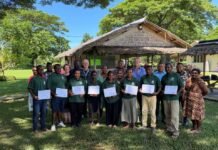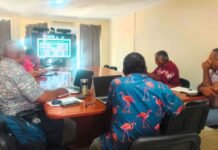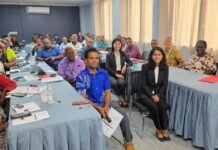

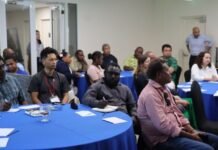

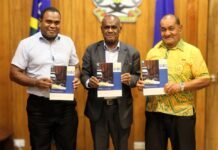
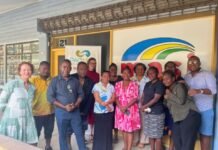
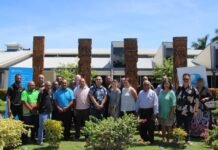
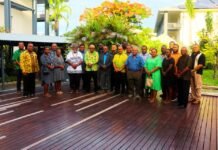







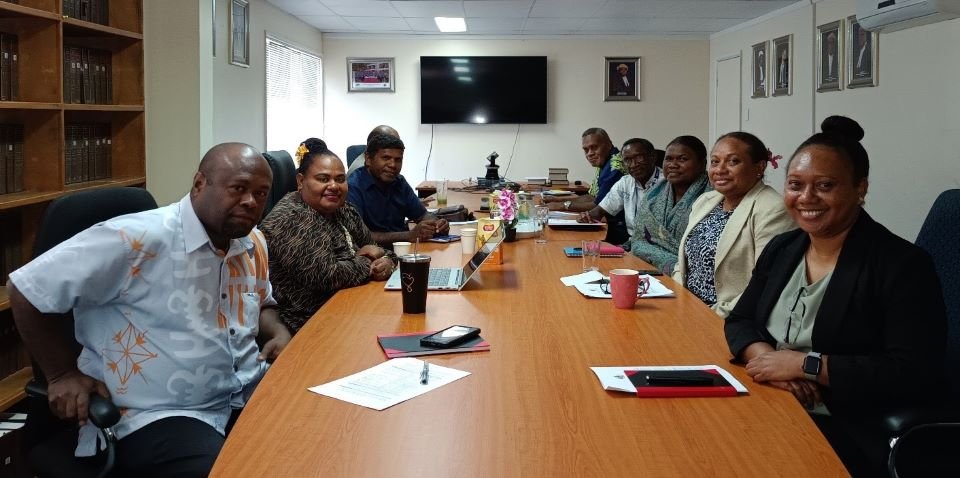
In a landmark step to empower young Solomon Islanders and strengthen the rule of law, the Attorney-General, John Muria (Jnr), today convened a high-level inter-ministerial meeting at the Attorney-General’s Chambers to advance the implementation of the Compulsory Legal Education Project, targeted for nationwide rollout in schools by 2028.
The meeting brought together senior officials from the Ministry of Justice and Legal Affairs (MJLA), the Ministry of Education and Human Resources Development (MEHRD), and the Prime Minister’s Office (PMO) to coordinate policy, curriculum development, and institutional responsibilities required for successful implementation.
The Compulsory Legal Education Project is a flagship reform initiative of the Attorney-General’s Chambers and forms part of the Government for National Unity and Transformation (GNUT) Policy Reform Agenda, particularly under the pillars of good governance, social stability, youth empowerment, and access to justice.
With more than 70 per cent of the population under the age of 35, Government has identified an urgent need to ensure young people are equipped with a basic understanding of the law, their rights and responsibilities, and the role of public institutions. This is seen as a critical strategy to promote lawful behaviour, civic responsibility, social cohesion, and long-term national stability.
The initiative represents a historic first for Solomon Islands, introducing structured legal studies into the national school curriculum, a reform not previously undertaken by any government. The programme will provide students with foundational knowledge of the Constitution of Solomon Islands, the functions of the Executive, Legislature and Judiciary, and the practical relevance of law in everyday life.
“This is about empowering our young people with knowledge, building respect for institutions, and strengthening national unity,” said Attorney-General Muria. “An informed citizenry is essential to sustaining democracy, preventing conflict, and supporting development.”
The project framework recognises that access to legal education is a key pillar of access to justice, and that early exposure to civic and constitutional principles promotes nationalism, patriotism, and responsible citizenship.
At the conclusion of the first working group meeting for 2026, the Attorney-General reaffirmed Government’s commitment to ensuring that by 2028, every student in Solomon Islands will have the opportunity to learn and understand the basic legal systems that govern their society, laying the foundation for a future defined by the rule of law, accountability, and informed participation in national life.