




























BY LIONEL TAORAO – ISLES FREELANCER
The Ulawa/Ugi health zone in the Makira/Ulawa Province has recorded a worrying surge in neonatal deaths this year, prompting calls for urgent health interventions across the province.
Recent Makira Ulawa Provincial Health Profile 2025 shows that out of the five health zones in Makira Ulawa Province, Ulawa/Ugi’s neonatal mortality rate skyrocketed to 71.4 percent in 2025 — one of the highest rates recorded in the province. The situation reflects deeper gaps in rural health services and maternal care delivery.
Neonatal deaths refer to the deaths of newborn babies within the first 28 days of life — a critical period that reflects the quality of maternal health care, delivery services, and early newborn care.

Health officers explain that contributing factors to high neonatal deaths often include limited access to skilled birth attendants, shortages of essential drugs and equipment, poor antenatal care, infections, premature births, and complications during delivery. In remote areas like Ulawa and Ugi, transportation and delayed referrals also increase risks for both mothers and infants.
Health workers on Ulawa say that there is an urgent need for improved maternal and child health services, better resourced clinics, and upgraded health facilities. They also emphasize the importance of having a pediatrician — a doctor who specializes in children’s health — based in rural areas to provide regular medical attention to newborns and young children.
“If we have a pediatrician stationed here like we used to years back would make a huge difference. Many newborn complications could be managed early before they become life-threatening,” said one health worker on Ulawa.
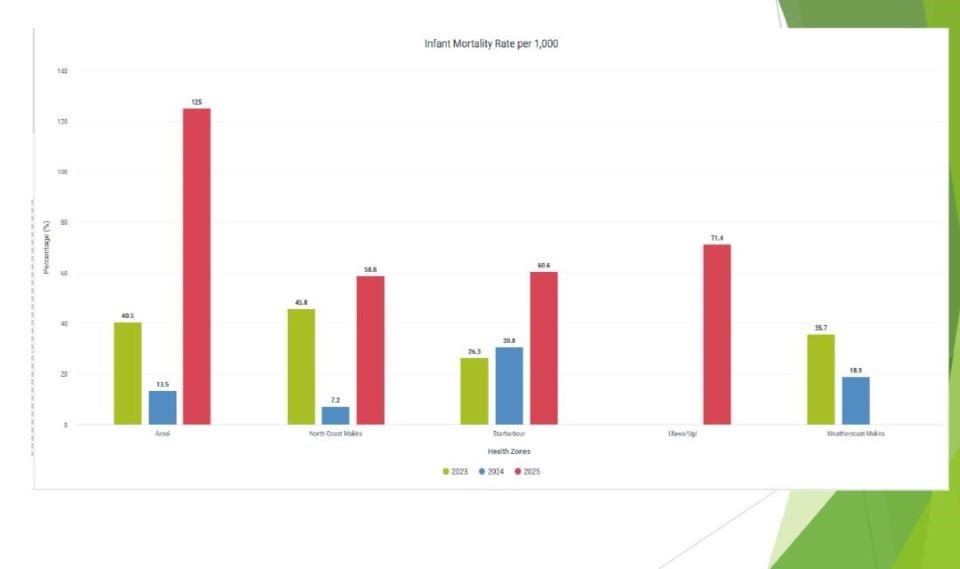
The data also revealed a worsening trend in Arosi, where neonatal deaths reached 100 percent this year — up from just 13.5 percent in 2023 — suggesting severe challenges in newborn survival rates in both areas.
Other zones showed mixed or incomplete results, with North Coast Makira fluctuating between 19.6 percent in 2023 and 14.7 percent in 2025, while Star Harbour and Weather coast Makira recorded single-year data of 30.8 and 35.7 percent respectively.
In addition to that, Infant mortality rate In Ulawa/Ugi too rose sharply. The rate rose sharply to 27.1 deaths per 1,000 live births in 2025, marking the highest figure jumping from 25.3 in 2024 to 69.6 in 2025—almost tripling within a year. Similarly, North Coast Makira experienced a steady climb, from 7.2 in 2023 to 51.8 in 2025.
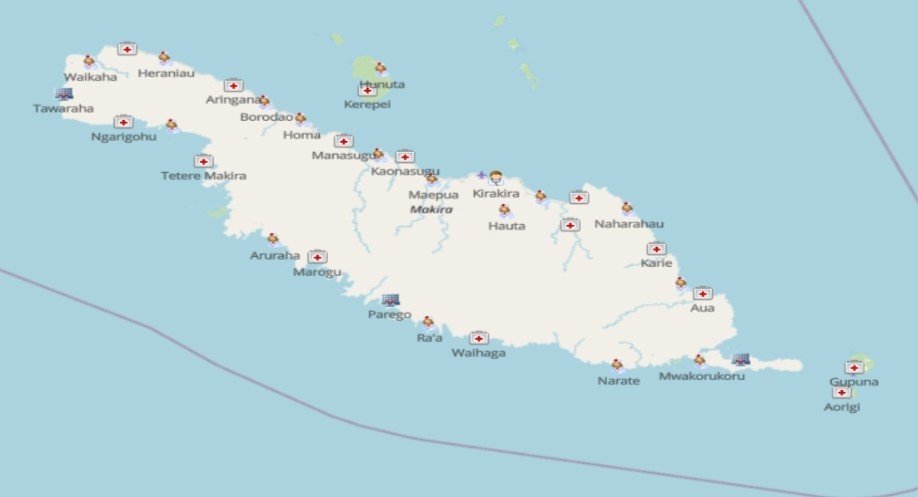
Meanwhile, Arosi remained relatively stable over the three-year period, with minor fluctuations between 11.5 and 13.1 per 1,000 live births, suggesting better service delivery or access to maternal health care. West Makira recorded a sharp rise between 2023 and 2024—from 11.6 to 53.7—before showing a slight decline in 2025.
The report shows that the rise could be linked to challenges in maternal and newborn care, lack of skilled health workers, poor access to health facilities, and logistical difficulties in remote communities.
The alarming trend in Ulawa/Ugi and Arosi has raised concerns among health authorities and communities, calling for targeted interventions, improved maternal and child health services, and better resource allocation to rural health facilities.