














STORY BY ASHLEIGH WYSS
Visiting Melbourne days after Pacific journalists were barred from a press briefing with Australian Prime Minister Anthony Albanese during the Pacific Islands Forum (PIF) in the Solomon Islands capital of Honiara, a move widely criticised as undermining press freedom, veteran Solomon Islands journalist Dorothy Wickham described the “snub” as emblematic of a broader lack of respect for Pacific journalists and journalism.
When reporting Pacific affairs, the Australian media consistently emphasises geopolitics and regional power rivalries, selecting and interpreting issues through an Australian lens at the expense of stories exploring the everyday realities of life in the Pacific, Wickham said.
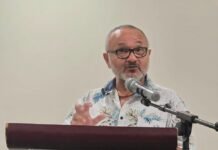
“For a country that sits smack bang in the Pacific and calls itself a Pacific island country, it’s shameful. It’s shameful that you don’t have Pacific news in your domestic coverage,” Wickham told a 17 September forum hosted by the University of Melbourne’s Oceania Institute.
“It’s obvious that until something big happens on the ground – somebody gets shot, there’s a coup or there’s a riot, there’s a cyclone or an earthquake or a volcano erupts – then we get into the Australian newspapers, but only maybe for a day, depends, sometimes maybe for half a day.”
Pacific stories need to be more effectively mainstreamed into Australian domestic news, not siloed as foreign affairs, argued Wickham, who is recognised for her deep understanding of the region. She was the longstanding host of the national radio talkback program ‘Talking Truth’, part of the Australian led Regional Assistance Mission to Solomon Islands (RAMSI), which ran from 2003 to 2017. She was also managing editor of One News Television, founding editor of the Melanesia News Network, and coordinator of not for profit cChange – Solomon Islands.
Her comments come as newsrooms across the Pacific grapple with the erosion of budgets and resources as advertisers and readers move online and away from legacy media, and increasing concerns about political influence and other constraints on media freedom.
Further blows to jobs, capacity and training have played out this year with the shutdown of the United States Agency for International Development (USAID) by US President Donald Trump. USAID previously underwrote a range of independent media operations and training programs.
Joining Wickham for the forum were two distinguished Australian Pacific journalism experts who witnessed the fallout from those cuts up close – Sue Ahearn, the former editor of Benar News, a Radio Free Asia affiliated news agency, and Mary-Louise O’Callaghan, project director for global media strengthening NGO Internews’ Transparent Pacific Media Project. Benar News was shuttered and Internews’ operations in the region substantially wound back.
“There’s a total of three and half thousand journalists who have actually been affected by this,” said Ahearn, founder of The Pacific Newsroom and formerly of Radio Australia. “So it’s been a really tough time, not so much for us in Australia, but for the Pacific journalists who’ve lost the opportunity to provide stories for a really credible media outlet.
“One of the things that we felt really strongly about, and was part of our strategy, was hiring journalists in the Pacific who were writing for us part time, but because they were well paid they able to prop up their own media organizations. That was a way of subsidising them so they could exist.”

Financial insecurity is consistently cited as a major concern for Pacific media workers and the most critical threat to independent journalism in the region according to the Pacific Freedom Forum’s 2023 Media Freedom Index and Report, a pilot survey of Pacific media workers contributed to by O’Callaghan through Internews.
Limited advertising revenue, marginal profits, and a mass exodus of seasoned journalists into higher paying public relations and communications roles have battered Pacific newsrooms. The “digital disruption” – that is, the advent of social media and the dominance of online news – came later to the Pacific, but is now hitting regional media hard, according to Wickham, noting loss of revenue and cutbacks on staff in print newsrooms.
In this precarious environment, the Media Freedom Index and Report found 60 per cent of Pacific journalists confessed to practicing self-censorship due to fear of reprisals from their communities, families or governments.
The failure to establish fact checking bodies has contributed to a rise in press release journalism, where regurgitated content is published by media outlets with minimal scrutiny, the panellists agreed.
As Western funding recedes, the speakers reflected on how Chinese state-linked media and training offers are moving in to fill the vacuum, expanding Chinese influence around the region through offering equipment, paid trips and financial support for local media in exchange for “favourable coverage”.
“One or two of our media organisations did fall into that trap.” Wickham said. “And of course, when you start asking for something and offering something in return, of course you are going to get bitten or burnt.
“I think they’ve learned from that now, trying to avoid being obligated to keep the donor happy. Slowly, I see there’s a change in the mindset … there’s certain agreement now amongst the media houses that, yes, we want their money, but we’re not going to let them tie us up by the and pull us around like a puppy dog.”

O’Callaghan – a Gold Walkley award winning journalist who has covered the region for decades – said Australia, alongside Europe and the United Kingdom continue to provide some programs to support Pacific media training.
From the Australian end, this is primarily conducted through Department of Foreign Affairs and Trade (DFAT) funded programs like Pacific Media Assistance Scheme (PACMAS) run by the Australian Broadcasting Corporation (ABC) International Development.
Wickham has been outspoken in the past about government led, all-expenses-paid trips for Pacific journalists to China, which she herself attended alongside a delegation of Solomons Islands journalists in 2019. She said regardless of its source, external financial assistance for Pacific media must be focused on providing genuine, useful support and skills relevant to the Pacific context.
“If the training and the traveling is going to bring back something for us to use on the ground, enhances our work, grows our reach, enhances our understanding and knowledge of our own islands, islands and states, then it’s a good thing,” Wickham said.
“But if it’s just a show by the donor countries to say that, look, we are helping too, not just them … then it becomes a problem.”
Dorothy Wickham visited Melbourne with support of the Oceania Institute, hosted by the Centre for Advancing Journalism. She also spoke to ABC’s Pacific Beat program about the challenges navigating geopolitical influence and funding.